Choosing the right solar charge controller with display can make system setup easier and day-to-day monitoring far more convenient. A clear screen helps you verify charging status, battery voltage, and operating mode at a glance.
In this roundup, we focused on controllers that balance performance, compatibility, and easy-to-read displays for different battery types and off-grid setups.
Best 10 Solar Charge Controller with Display Picks for 2026
High-Capacity MPPT Expandability
PowMr 100A MPPT Solar Controller

- 100A MPPT with LCD display
- Works with 12V to 48V systems
- Supports lead-acid and lithium batteries
Best For: Larger expandable solar systems
Simple 12V PWM Setup
12V 20A PWM Solar Controller with LCD
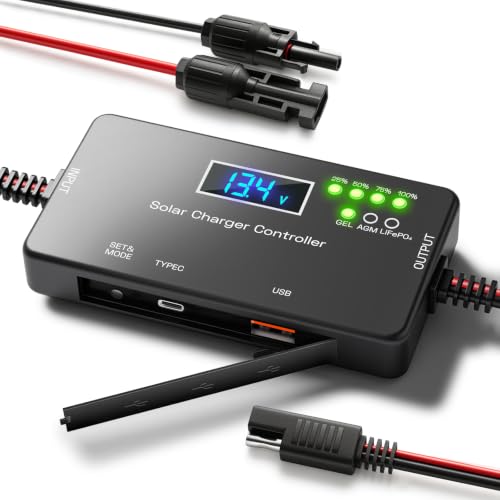
- LCD shows battery voltage and charge level
- Supports 12V LiFePO4, AGM, and Gel batteries
- Easy quick-connect wiring with USB ports
Best For: Small 12V RV, boat, or shed systems
Bluetooth MPPT Monitoring
Victron SmartSolar MPPT 100V 50A

- MPPT charging with Bluetooth app monitoring
- Shows real-time data and 30-day history
- Synchronizes with other SmartSolar controllers
Best For: Users who want app-based monitoring instead of LCD
Budget-Friendly LCD Control
30A PWM Solar Controller with Auto Display

- Auto-adapts to 12V and 24V systems
- LCD shows status and supports settings
- Compatible with lead-acid batteries only
Best For: Basic lead-acid systems needing an LCD
High-Power Smart Pick
100A MPPT Solar Charge Controller with LCD Display
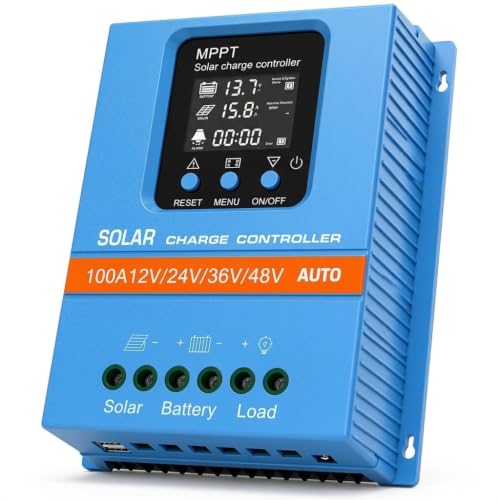
- 100A MPPT controller for 12V/24V/36V/48V systems
- LCD shows voltage, current, temperature, and error codes
- Works with sealed, GEL, flooded, and LiFePO4 batteries
Best For: Large off-grid systems and users who want detailed live monitoring
Easy Setup Value
100A MPPT Solar Charge Controller with Auto LCD

- 12V/24V auto-recognition makes setup straightforward
- LCD offers real-time performance and settings control
- Built-in protection helps prevent overcharging and reverse polarity
Best For: Plug-and-play solar users who want simple monitoring and setup
Compact Install Favorite
Renogy 30A PWM Controller with LCD Display

- Automatic 12V/24V detection for easier setup
- LCD plus DC Home App support for live monitoring
- Flush-mount design works well in RV and marine installs
Best For: RV, marine, and small off-grid setups needing a neat install
Elite High-Capacity MPPT Pick
100A MPPT Solar Charge Controller with LCD

- 100A capacity with auto 12V/24V/36V/48V detection
- LCD shows voltage, current, temperature, and mode
- Dual USB plus multiple control and timing modes
Best For: Larger off-grid systems and users who want detailed monitoring
Compact Timer-Friendly Budget Pick
30A PWM Solar Charge Controller LCD

- LCD shows voltage, current, and operating mode
- Timer function automates small loads and devices
- Dual USB and settings memory add convenience
Best For: Small off-grid projects and beginner-friendly DIY installs
Simple Lead-Acid Utility Pick
30A PWM Controller with LCD and USB

- LCD makes status checks and parameter changes easy
- Auto 12V/24V detection simplifies setup
- Dual USB and automatic protection add convenience
Best For: Lead-acid systems that need a simple, readable controller
High-Capacity MPPT Expandability – PowMr 100A MPPT Solar Controller
If you need a solar charge controller with display for a larger off-grid setup, this PowMr MPPT model is built for scale. It supports 12V/24V/36V/48V systems, works with lead-acid and lithium batteries, and adds an LCD for checking system status during setup and use.
Best For: Larger solar systems that may expand over time and need high-current MPPT charging with LCD monitoring.
Pros:
- 100A MPPT design with up to 99% tracking efficiency and 97% peak conversion efficiency
- LCD display and support for 12V, 24V, 36V, and 48V system voltages
- Compatible with multiple battery types, including lead-acid and lithium
- Can support up to 12 units in parallel for system expansion
Cons:
- Higher-capacity unit than many small RV or shed setups need
- Setup may be more involved than simple PWM controllers
- Best suited for users who actually need the extra power headroom
This is a strong pick if you want room to grow, broad battery compatibility, and an easy-to-read display in one controller. Its main appeal is scale, but it still keeps the basics straightforward with built-in protection and multi-stage charging.
Simple 12V PWM Setup – 12V 20A PWM Solar Controller with LCD
This solar charge controller with display is aimed at small 12V systems that need a simple, readable controller. It supports LiFePO4, AGM, and Gel batteries, includes an LCD battery-level readout, and is rated for solar panels up to 300W.
Best For: Small 12V RV, boat, or shed systems that want easy wiring and a clear LCD screen.
Pros:
- LCD display shows battery voltage and 25%/50%/75%/100% charge levels
- Works with 12V LiFePO4, AGM, and Gel batteries
- Integrated quick-connect design makes installation easier
- Includes USB and Type-C fast-charging ports
Cons:
- Not compatible with 24V or 36V systems
- Limited to 300W of solar panel input
- PWM design is less advanced than MPPT for larger or more demanding systems
For basic 12V setups, this controller focuses on convenience and visibility rather than maximum expansion. The display, battery compatibility, and built-in charging ports make it practical for everyday use where simplicity matters most.
Bluetooth MPPT Monitoring – Victron SmartSolar MPPT 100V 50A
If you want a solar charge controller with display-style visibility through your phone, this Victron SmartSolar leans into app-based monitoring rather than an onboard screen. It uses MPPT charging, supports 12/24V systems, and gives you real-time data and history through VictronConnect.
Best For: Users who prefer Bluetooth app monitoring over an onboard LCD display.
Pros:
- SmartSolar MPPT design maximizes available solar output
- VictronConnect app provides real-time data and 30-day performance history
- Multiple controllers can synchronize for system-wide charging
- Intelligent load output adds useful low-voltage disconnect control
Cons:
- Does not include a built-in display
- App-based setup may not suit users who want a physical screen
- Higher-end features are more than basic systems may require
This is a strong choice for users who value precise monitoring and smart integration. It skips the onboard screen, but the Bluetooth app gives you detailed visibility and configuration tools that go beyond a simple display panel.
Budget-Friendly LCD Control – 30A PWM Solar Controller with Auto Display
For a straightforward solar charge controller with display, this 30A PWM model covers the basics well. It automatically adapts to 12V or 24V systems, shows working status on the LCD, and supports lead-acid battery types for home or utility use.
Best For: Simple 12V/24V lead-acid solar setups that need an LCD and easy automatic operation.
Pros:
- Auto-adapts to 12V or 24V systems without manual voltage setting
- LCD display shows working status and lets you configure parameters
- Built-in protections include overcurrent, short-circuit, reverse polarity, and overcharge
- Dual USB output adds convenient charging for small devices
Cons:
- Only compatible with lead-acid batteries
- Not suitable for lithium or NiMH batteries
- PWM design is less efficient than MPPT for some solar setups
This controller makes sense when you want a readable display and simple automatic setup without adding complexity. It is best viewed as a practical lead-acid option for smaller systems rather than a premium high-efficiency controller.
High-Power Smart Pick – 100A MPPT Solar Charge Controller with LCD Display
If you need a solar charge controller with display for a larger off-grid setup, the SA100A is built around high-current handling and detailed monitoring. It supports 12V/24V/36V/48V systems, recognizes common battery types including lead-acid and LiFePO4, and adds LCD readouts for real-time voltage, current, temperature, and error codes.
Best For: Larger solar systems, off-grid homes, and users who want a high-amperage controller with clear status data.
Pros:
- 100A MPPT design with claimed tracking efficiency of no less than 99.5%
- Large LCD display shows working voltage, PV input voltage, current, temperature, and error codes
- Supports 12V/24V/36V/48V systems and sealed, GEL, flooded, and LiFePO4 batteries
- Includes dual USB 5V charging ports plus load timing and light control functions
Cons:
- More controller than you need for small or simple solar installs
- Technical feature set may feel complex if you only want basic charging
- Best suited to setups that can take advantage of its higher current capacity
This model stands out if you want monitoring depth and flexible battery support in one unit. The combination of a large display, adaptive charging logic, and broad system compatibility makes it a practical choice for demanding applications.
Easy Setup Value – 100A MPPT Solar Charge Controller with Auto LCD
For buyers who want a solar charge controller with display that is easier to install and read, this 100A MPPT unit focuses on straightforward setup and real-time visibility. It uses 12V/24V auto-recognition, an LCD screen for system status, and built-in protections aimed at keeping charging safe and efficient.
Best For: Users who want a plug-and-play controller with a readable LCD and simple adjustment workflow.
Pros:
- Smart 12V/24V auto-recognition simplifies installation
- LCD display provides real-time performance updates and easy settings control
- Claims up to 99% efficiency for maximum charging current tracking
- Built-in protection against overcharging, short circuits, and reverse polarity
Cons:
- Only 12V/24V auto-recognition is highlighted in the notes
- Less feature-rich than controllers that add detailed load timing or broader voltage support
- Best fit for users comfortable with a more basic setup and feature set
This is a practical option if you want a controller that is easy to connect and easy to check at a glance. The LCD-centered design and simplified setup make it appealing for everyday solar charging tasks.
Compact Install Favorite – Renogy 30A PWM Controller with LCD Display
If you want a solar charge controller with display for an RV or compact off-grid build, the Renogy Adventurer 30A keeps things simple and installation-friendly. It automatically detects 12V/24V systems, uses an LCD for status checks, and adds flush-mount styling for a cleaner wall installation.
Best For: RV, marine, and small off-grid systems that benefit from a flush-mounted controller and clear LCD readout.
Pros:
- Automatic 12V/24V detection simplifies system setup
- LCD display and DC Home App support let you track real-time data
- Flush-mount design with surface kit included for cleaner installation
- Supports sealed, gel, flooded, and lithium batteries with temperature compensation
Cons:
- 30A PWM design is less powerful than the 100A MPPT options in this roundup
- Best suited to smaller systems rather than high-capacity builds
- Installation style is optimized for flush mounting, which may not fit every setup
This controller is a strong fit when you care more about ease of mounting and dependable day-to-day monitoring than maximum output. Its LCD display, app compatibility, and battery support make it a versatile choice for mobile and compact installations.
Elite High-Capacity MPPT Pick – 100A MPPT Solar Charge Controller with LCD
If you want a solar charge controller with display for a larger off-grid setup, this 100A unit stands out for its high-capacity output, automatic 12V/24V/36V/48V detection, and feature-rich LCD interface. It combines MPPT and PWM charging behavior, so it is best viewed as a versatile, value-focused controller with a monitor-friendly screen rather than a pure premium MPPT-only option.
Best For: Larger solar setups, mixed battery types, and users who want detailed on-screen system data.
Pros:
- LCD shows working mode, battery voltage, PV charging current, discharge current, temperature, and delay time.
- Supports 12V/24V/36V/48V systems with dual USB ports for small device charging.
- Includes multiple operating modes such as light control, timing control, and manual control.
- Offers broad protection features including over-voltage, over-current, reverse connection, overheating, and deep discharge protection.
Cons:
- The notes state it integrates both MPPT and PWM technologies, so it is not a full pure-MPPT controller.
- Its size and 100A capacity are more than many small DIY or maintenance applications need.
- Requires correct startup order: battery first, then solar panel.
This is the most feature-packed option in the group, especially if you value a display with real-time system information and flexible control modes. It makes sense for users who want broad battery compatibility and detailed monitoring in one controller.
Compact Timer-Friendly Budget Pick – 30A PWM Solar Charge Controller LCD
This solar charge controller with display is a practical fit for small off-grid projects where simple setup and timer control matter more than advanced power features. The 30A PWM design supports 12V/24V systems, adds dual USB charging, and gives you a backlit LCD for quick voltage and current checks.
Best For: Small trailers, garden lights, boat battery maintenance, and beginner DIY solar setups.
Pros:
- Backlit LCD shows real-time voltage, charging current, and mode information.
- Built-in timer function helps automate small loads like pumps, fans, or lights.
- Dual USB ports provide convenient 5V charging without extra adapters.
- Built-in memory saves settings after a power outage, reducing reconfiguration.
Cons:
- Notes describe it as a PWM controller, so it is not the choice for users seeking MPPT charging.
- Lithium batteries require manual mode selection before connecting panels.
- Best suited to small systems rather than higher-demand solar builds.
Overall, this model is a straightforward pick for users who want an easy-to-read display and timer automation in a compact controller. It is especially appealing if you need basic control for small loads and want something simple to operate.
Simple Lead-Acid Utility Pick – 30A PWM Controller with LCD and USB
If you need a solar charge controller with display for a basic lead-acid system, this 30A PWM model keeps the controls simple and practical. It auto-detects 12V or 24V systems, uses an LCD for status readouts and adjustments, and includes dual USB output for everyday low-power charging.
Best For: Lead-acid battery systems in home, industrial, or commercial small-load applications.
Pros:
- LCD display makes it easy to read status and adjust battery parameters.
- Supports 12V/24V auto-detection for straightforward installation.
- Dual USB 5V/3A ports can charge phones, tablets, and other small devices.
- Automatic recovery protection covers overcurrent, short circuit, reverse connection, and open circuit events.
Cons:
- Notes clearly say it is not suitable for lithium batteries.
- Designed for lead-acid batteries only, which limits compatibility.
- Less feature-rich than models with timing or multi-mode load control.
This controller is the most straightforward option here for users staying within lead-acid battery chemistry. It offers the core display, protection, and USB conveniences without adding unnecessary complexity.
How We Picked the Best Solar Charge Controller with Display
We prioritized display clarity, charging technology, system compatibility, current capacity, and practical features such as auto-recognition, USB outputs, and battery-type support. A Solar Charge Controller with Display should do more than show numbers; it should help you understand your system quickly and set it up correctly.
Quick Comparison
MPPT models are typically the best choice if you want higher charging efficiency, especially in larger or more variable solar setups. PWM models are usually more affordable and can be a strong fit for smaller systems where panel and battery voltages are closely matched. Higher-amperage units are better for bigger arrays, while 20A to 30A options suit compact RV, cabin, or backup applications.
Key Buying Factors for a Solar Charge Controller with Display
Charging Type
MPPT controllers convert excess voltage into usable charging current, which can improve energy harvest. PWM controllers are simpler and often cheaper, but they work best when your panels are sized appropriately for the battery bank.
System Voltage and Current
Check whether the controller supports 12V, 24V, 36V, or 48V systems, and make sure the amperage rating exceeds your expected solar input. Oversizing slightly can provide room for future expansion and reduce the risk of running the unit near its limit.
Battery Compatibility
Look for support for LiFePO4, AGM, Gel, flooded lead-acid, or sealed batteries, depending on what you use. If you plan to upgrade batteries later, choose a controller with adjustable charging parameters and clear battery presets.
Display and Monitoring Features
The display should be easy to read in bright light and show the essentials: charging current, battery voltage, load status, and error alerts. Some units also include USB ports, timers, or auto-parameter recognition, which can be useful in simple off-grid builds.
Who Should Buy Which Solar Charge Controller with Display?
If you want the best efficiency for a larger array, choose an MPPT controller with a robust display and wide voltage support. If you are building a budget-friendly small system, a PWM model with an LCD can be enough. For RVs, cabins, and DIY backup power, the best choice is usually the one that matches your battery chemistry, system size, and need for easy monitoring in a Solar Charge Controller with Display.