When cold weather sets in, the right pond heater can help keep a small opening in the ice for oxygen exchange and improve winter survival for fish.
This roundup of the best backyard pond heater for winter options focuses on practical performance, winter durability, and the features that matter most to pond owners.
Best 10 Backyard Pond Heater for Winter Picks for 2026
Energy-Saving Floating De-Icer

- 100W floating pond de-icer
- Maintains a 12-inch ice opening
- Safety listed for outdoor use
Best For: Small fish ponds needing a low-wattage floating de-icer
Thermostatic Floating De-Icer

- 120W floating pond de-icer
- Fixed thermostat helps save electricity
- Safe for liners and pre-formed ponds
Best For: Small ponds up to 250 gallons
Submersible Winter De-Icer
K&H Thermo-Pond Perfect Climate 8in

- 300W thermostatically controlled de-icer
- Safe for all pond materials
- Keeps an open hole for oxygen exchange
Best For: Ponds needing submersible, material-safe winter de-icing
Chew-Proof Dual-Pack De-Icer
Farm Innovators Floating All Pond

- Two-pack floating pond de-icer
- Self-regulating thermostat
- Chew-proof cord and caged barrier
Best For: Koi or planted ponds needing a protected two-pack de-icer
Stone-Finish Ice Breaker
TetraPond Thermostatic Pond De-Icer

- Keeps a pond opening free from ice
- Allows toxic gases to escape in winter
- Thermostatic shutoff with 15-foot cord
Best For: Pond owners who need a basic, thermostatically controlled winter ice opening
Floating Winter Heater
HITOP 300W Outdoor Pond Heater

- Creates ice holes for fish to breathe
- Floatable foam and 16.4-foot cord
- Thermostat holds 68-72°F near heater
Best For: Small outdoor ponds needing a floating, thermostatic de-icer
Energy-Saving Floater
Dreyoo 100W Floating Pond De-Icer

- 100W low-power design for economical use
- Thermostat switches at 60°F
- Floatable and safe for liners or plastic ponds
Best For: Energy-conscious pond owners wanting a small winter ice opening
Compact Thermostatic De-Icer
500W Submersible Stock Tank Heater
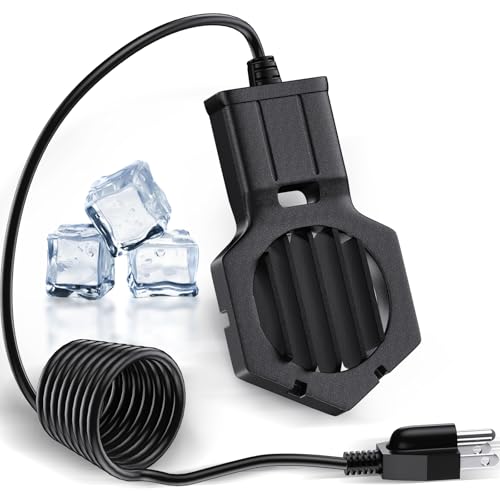
- Thermostatic control helps save electricity
- Rated for containers from 5 to 50 gallons
- 10 ft cold-resistant waterproof cord
Best For: Small ponds, tanks, and bird baths
Safety-First Floating De-Icer
TURBRO 400W Stainless Steel Pond De-Icer

- IP68 rating with overheating protection
- 32.8 ft UL-approved cord for flexible placement
- Stainless steel casing with status indicator light
Best For: Outdoor pond owners prioritizing safety and cord reach
Floating Koi Pond Heater
Saillong 500W Temp-Control Pond De-Icer

- Floats on the surface to keep ice openings
- Temperature control shuts off if too hot
- Stainless steel body with 9.84 ft grounded cord
Best For: Medium koi and outdoor ponds from 100 to 250 gallons
Energy-Saving Floating De-Icer – K&H Thermo-Pond 3.0 12in 100W
If you need a backyard pond heater for winter that focuses on keeping a hole open for oxygen exchange, this floating de-icer is built for the job. It uses 100 watts to maintain a 12-inch opening in the ice, making it a practical option for fish ponds where energy use and basic winter protection both matter.
Best For: Small backyard ponds with fish that need a low-wattage floating de-icer.
Pros:
- Uses only 100 watts for low operating cost.
- Maintains a 12-inch hole in pond ice for gas exchange.
- Floats on top of the water and is safe with pond liners or plastic ponds.
- Safety listed and tested to exceed USA/CA electrical safety standards.
Cons:
- Will not keep other areas of the pond open.
- Pond should be at least 18 inches deep.
- Requires snow to be cleared from the top to prevent issues.
For pond owners who want a straightforward winter de-icer rather than full-pond heating, this model keeps the focus on fish safety and efficient operation. Its floating design and certification-backed safety approach make it a solid, simple choice for cold-weather pond care.
Thermostatic Floating De-Icer – Pondmaster 02175 Red
This backyard pond heater for winter is designed to keep a small opening in frozen pond surfaces so harmful gases can escape and fish can stay alive through cold months. With fixed thermostatic control and a floating design, it aims to reduce heating time while still delivering practical winter protection.
Best For: Small ponds up to 250 gallons that need a thermostatically controlled floating de-icer.
Pros:
- Fixed thermostatic control reduces heating time and saves electricity.
- Helps maintain a small opening for gas release and fish survival.
- Epoxy-sealed internal electronics for watertight protection.
- Safe for flexible liners and pre-formed ponds.
Cons:
- Rated for ponds up to 250 gallons.
- Uses 120 watts, which is higher than low-watt options.
- Includes a 1-year limited warranty only.
For pond owners who want a no-frills floating de-icer with automatic thermostat control, this model offers a balanced mix of efficiency and function. It is especially useful where ice buildup is a recurring problem and maintaining a vent hole is the main priority.
Submersible Winter De-Icer – K&H Thermo-Pond Perfect Climate 8in
If you want a backyard pond heater for winter that works with a wider range of pond materials, this submersible de-icer is worth a look. It is thermostatically controlled to turn on and off as needed, and it is designed to keep an open hole in the ice for oxygen exchange without requiring cages or guards.
Best For: Ponds that need a thermostatically controlled submersible de-icer with material-safe operation.
Pros:
- Thermostatically controlled for automatic on/off operation.
- Keeps a hole open in the ice for oxygen exchange.
- Safe for all pond materials, including preformed ponds and liners.
- No cages or guards needed.
Cons:
- Not a floating style unit.
- Higher 300W power draw than low-watt models.
- Detailed pond size guidance is not listed in the supplied notes.
This is a practical choice if you want the simplicity of thermostatic operation and broader compatibility with pond materials. It is built around winter oxygen exchange, making it a focused solution for fish ponds in freezing weather.
Chew-Proof Dual-Pack De-Icer – Farm Innovators Floating All Pond
When you need a backyard pond heater for winter that supports both fish and plants, this two-pack floating de-icer is aimed at keeping a vent hole open in the ice. It uses a self-regulating thermostat and a caged design to help maintain a secure, winter-ready pond environment.
Best For: Backyard koi ponds and planted ponds that need a secure floating de-icer in a two-pack.
Pros:
- Two-pack provides extra coverage or a backup unit.
- Self-regulating thermostat operates only when necessary.
- Chew-proof cord protector adds durability around wildlife.
- Caged barrier helps make it safer for fish and pond plants.
Cons:
- Pack format may be more than some small ponds need.
- Floating design may not suit buyers who want a submersible unit.
- Specific wattage is not provided in the supplied notes.
This option stands out if you want a more protected design and the convenience of two units in one purchase. It is especially appealing for pond owners who want to support a healthy winter ecosystem while reducing the chance of accidental cord damage.
Stone-Finish Ice Breaker – TetraPond Thermostatic Pond De-Icer
If you want a straightforward backyard pond heater for winter, this TetraPond de-icer is built to keep a section of ice open so gases can escape while fish stay safer under the surface. Its thermostatic control and 300-watt output make it a practical option for ponds that need a dependable winter survival solution rather than full-pond heating.
Best For: Pond owners who want a simple, thermostatically controlled ice-free opening with a natural-looking finish.
Pros:
- Keeps an area of the pond free from ice.
- Helps toxic gases escape from decaying matter during winter.
- Works in temperatures as low as -20 degrees.
- Includes a 15-foot power cord and thermostatic shutoff.
Cons:
- Designed to maintain an opening, not heat the entire pond.
- Stone finish is mainly aesthetic and doesn’t change performance.
For ponds that mainly need winter aeration support and ice relief, this is a solid low-fuss choice. The thermostatically controlled shutoff helps reduce unnecessary runtime, while the 300-watt design stays focused on creating a safe opening in the ice.
Floating Winter Heater – HITOP 300W Outdoor Pond Heater
This backyard pond heater for winter is aimed at small outdoor ponds that need a warm spot near the unit to slow freezing and create breathing holes for fish. The HITOP 300W model uses constant-temperature control and a floatable foam design, which makes it a useful pick when you want targeted de-icing rather than whole-pond heating.
Best For: Small to medium outdoor ponds that need a floating de-icer with a long cable and automatic temperature control.
Pros:
- 300W design helps heat water near the heater and melt ice holes.
- Floatable foam keeps the unit on the water surface.
- Thermostatic control maintains 68-72°F around the heater.
- 16.4-foot cable and 3-pin plug improve placement flexibility.
Cons:
- Not intended to heat the entire pond.
- Not recommended for plastic ponds.
- Heating efficiency depends on outdoor weather.
If you want an easy-to-place de-icer with automatic control, this model offers a balanced mix of convenience and function. It’s especially useful where a floating layout and long cord make installation simpler in cold weather.
Energy-Saving Floater – Dreyoo 100W Floating Pond De-Icer
For buyers looking for a lower-watt backyard pond heater for winter, the Dreyoo floating de-icer focuses on efficiency and simple operation. Its 100-watt design is meant to keep a minimum opening in the ice, release harmful gases, and maintain a safer environment for fish without drawing as much power as higher-watt options.
Best For: Pond owners who want an energy-conscious floating de-icer for fish and plants through cold weather.
Pros:
- 100W low-power design is intended to be more economical.
- Thermostat turns on below 60°F and off above 60°F.
- Floatable build is safe for pond liners or plastic ponds.
- Creates a minimum 12-inch ice opening for venting harmful gases.
Cons:
- Lower wattage means it heats a smaller area near the unit.
- Heating performance can vary with outdoor weather.
This is a sensible pick if efficiency matters more than raw heating power. It’s built around maintaining a small but useful opening in winter ice, making it a practical maintenance tool for stocked backyard ponds.
Compact Thermostatic De-Icer – 500W Submersible Stock Tank Heater
If you need a backyard pond heater for winter that can also handle stock tanks and bird baths, this 500W submersible de-icer is built for practical cold-weather use. It is designed to stay fully submerged, switch on near freezing, and help keep water usable in containers from 5 to 50 gallons.
Best For: Small ponds, livestock tanks, bird baths, rain barrels, and other compact water containers that need dependable ice prevention.
Pros:
- Thermostatically controlled to run only when water is near freezing
- 500W output is rated to melt more water up to 50 gallons
- Aluminum body has anti-rust coating and is designed to be non-conductive
- 10 ft cold-resistant, waterproof cord for easier placement
Cons:
- Must be completely submerged to work correctly
- Best suited to smaller water volumes rather than large backyard ponds
This is a straightforward choice if your priority is keeping smaller outdoor water sources from freezing without adding unnecessary complexity. Its thermostat and insulated build make it a practical winter utility heater more than a decorative pond accessory.
Safety-First Floating De-Icer – TURBRO 400W Stainless Steel Pond De-Icer
For a backyard pond heater for winter where safety and cord reach matter, this TURBRO floating de-icer brings a strong feature set. It uses a stainless steel casing, built-in overheating and power-off protection, and a GFCI leakage protection plug to help manage outdoor pond conditions more confidently.
Best For: Pond owners who want a longer cord, strong safety protections, and a floating de-icer for outdoor fish ponds.
Pros:
- IP68 water resistance with overheating and power-off protection
- UL-approved 32.8 ft cord provides flexible placement
- Full stainless steel casing resists rust and corrosion
- Indicator light shows when heating is active or paused
Cons:
- 400W output may be less aggressive than higher-watt options
- Designed as a pond de-icer rather than a general-purpose tank heater
This model stands out if electrical safety and installation flexibility are your top concerns. The long cord and visible status light make it easier to place and monitor than many basic pond heaters.
Floating Koi Pond Heater – Saillong 500W Temp-Control Pond De-Icer
If you want a backyard pond heater for winter that is aimed specifically at keeping koi and outdoor ponds from freezing solid, this 500W floating deicer is a solid fit. It floats on the surface to help maintain an opening in the ice for oxygen exchange, and its temperature control is meant to shut the unit off when heat gets too high.
Best For: Medium outdoor ponds from 100 to 250 gallons, especially koi, turtle, and yard ponds that need ice management.
Pros:
- 500W floating design helps keep a hole open in the ice
- Temperature control protection prevents overheating
- Stainless steel construction resists rust and is easy to clean
- 9.84 ft UL-certified grounded cord for outdoor use
Cons:
- Only suitable for ponds in the 100 to 250 gallon range
- Floating style may not suit buyers who prefer a submerged heater
This heater is a good winter survival tool when your main goal is preventing a pond from freezing over completely. It is best viewed as a functional pond de-icer for maintaining oxygen exchange rather than a broad-use heater.
How We Picked the Best Backyard Pond Heater for Winter
We looked for pond heaters and de-icers that are built for cold-weather use, sized for different pond capacities, and designed to support safe winter operation. Priority went to thermostatic control, cord length, ice-management design, material durability, and safety features such as protective housings or leakage protection.
Because every Backyard Pond Heater for Winter works best in a different setup, we also considered whether a model is better for small decorative ponds, koi ponds, or larger water features that need more wattage and wider ice relief.
Quick Comparison
Use lower-wattage units for smaller ponds or mild winters, and step up to higher-wattage de-icers for larger ponds, deeper freezes, or more exposed installations. Floating models are often easier to place, while submersible options can be more discreet and efficient in the right conditions.
Key Buying Factors for Backyard Pond Heater for Winter
Pond Size and Climate
The first factor is matching heater output to pond size and your local winter lows. A unit that is too small may not keep an opening in the ice, while an oversized model can waste electricity.
Floating Vs. Submersible Design
Floating de-icers are simple to position and can be a strong choice for many backyard setups. Submersible heaters may suit ponds where a lower-profile look or more direct heat placement is preferred.
Thermostat and Energy Use
Thermostatic control helps the heater run only when needed, which can reduce energy use and limit unnecessary wear. For a Backyard Pond Heater for Winter, that efficiency can matter over long cold spells.
Safety and Cord Features
Look for chew-resistant cords, long power leads, and safety protections such as GFCI-compatible designs. Durable housings, anti-sinking features, and corrosion-resistant materials also help in harsh weather.
Who Should Buy Which Backyard Pond Heater for Winter?
Choose a compact, lower-wattage heater if you have a small ornamental pond or live in a region with occasional frost. Go with a thermostatically controlled floating or submersible de-icer if you keep fish and want dependable ice relief through the season.
If your pond is larger, more exposed, or regularly sees hard freezes, prioritize higher wattage, stronger housing, and longer cords for easier placement. The best choice is the one that fits your pond size, your winter climate, and how hands-on you want the setup to be.