Choosing the right charge controller can make or break a solar setup. The best models protect your batteries, improve charging efficiency, and help you match panel output to your system.
Below, we focus on the top solar charge controllers for different budgets and use cases, from simple PWM units to feature-rich MPPT options.
Best 10 Solar Charge Controllers Picks for 2026
Premium Bluetooth MPPT
Victron SmartSolar MPPT 100V 50A

- Fast MPPT tracking for shaded or changing conditions
- Bluetooth app shows live data and 30-day history
- Can synchronize with other SmartSolar MPPT units
Best For: Off-grid systems that need advanced monitoring and high-efficiency charging
Compact RV PWM

- Compact 12V PWM controller for small systems
- Supports lithium, AGM, gel, and flooded batteries
- LEDs and built-in protections simplify daily use
Best For: Small RV, marine, and 12V off-grid setups
Small Smart MPPT
Victron SmartSolar MPPT 75V 15A

- Bluetooth MPPT controller for 12/24V systems
- App gives live data, history, and settings control
- Compact size with synchronized charging support
Best For: Compact solar systems that need smart monitoring and efficient charging
Advanced All-Weather MPPT

- MPPT controller with 12V/24V auto-detection
- Supports gel, AGM, flooded, and lithium batteries
- LCD display plus app support with BT-2 module
Best For: Rugged off-grid systems needing flexible battery support and monitoring
Premium MPPT Pick
Victron BlueSolar MPPT 75V 15A

- Fast MPPT tracking helps capture more power in shade
- Supports AGM, Gel, LiFePO4, and flooded batteries
- Optional Bluetooth monitoring via dongle
Best For: efficient charging in compact 12V/24V setups
Budget RV Choice
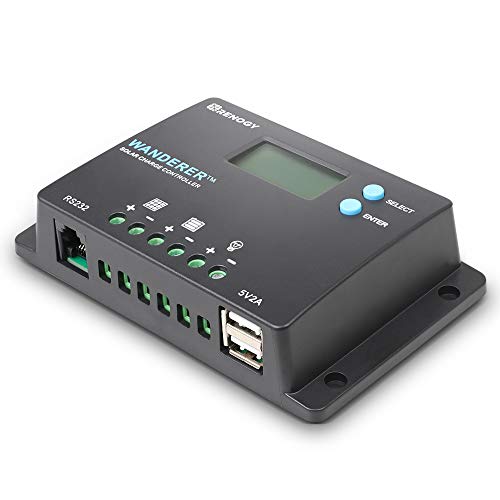
- 4-stage charging supports common battery types
- Compact IP32 design suits RV and marine installs
- LCD plus load control modes add everyday convenience
Best For: small RV or marine solar systems
Feature-Rich MPPT Option

- 30A MPPT design with automatic 12V/24V support
- LCD screen and memory function simplify setup
- Dual USB ports add direct device charging
Best For: users wanting a convenient mid-range MPPT controller
Waterproof Thin-Profile Pick
LNEX 10A Waterproof PWM Controller
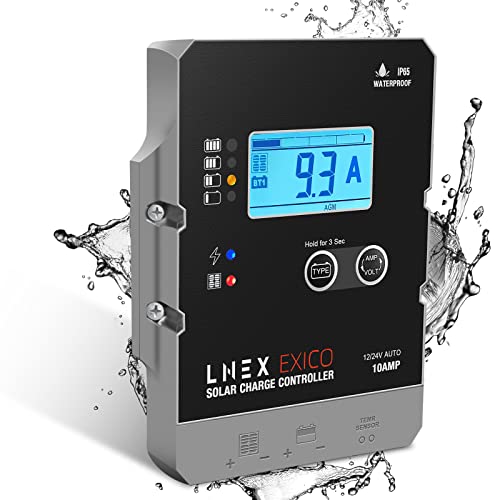
- IP65 waterproof housing
- 5-stage PWM charging
- LCD display with 12V/24V auto-detect
Best For: Small outdoor systems needing waterproof, simple control
High-Capacity Upgrade
100A MPPT-Style Solar Controller

- Supports 12V to 48V systems
- LCD with detailed operating data
- Dual USB and multiple control modes
Best For: Larger systems needing high current capacity and monitoring
Lead-Acid Value Pick
30A PWM Controller with Dual USB

- Automatic 12V/24V detection
- Dual USB 5V/3A charging
- Not for lithium batteries
Best For: Lead-acid systems that need simple control and USB charging
Premium Bluetooth MPPT – Victron SmartSolar MPPT 100V 50A
If you want solar charge controllers that prioritize efficiency, the Victron SmartSolar MPPT 100V 50A is built for high-output systems where squeezing the most from each panel matters. It uses fast MPPT tracking, supports synchronized operation with other Victron units, and includes Bluetooth app access for monitoring and setup.
Best For: Off-grid users who want a feature-rich MPPT controller with strong monitoring and system expansion options.
Pros:
- Fast MPPT tracking helps maximize available solar power, even in partial shade.
- VictronConnect Bluetooth app provides real-time data, 30-day history, settings changes, and firmware updates.
- Multiple units can synchronize to work together for system-wide charging coordination.
- Includes intelligent load output with configurable low-voltage disconnect behavior.
Cons:
- Pricier and more advanced than basic solar charge controllers.
- No built-in display, so app access is the main way to monitor and configure it.
Overall, this is a strong pick if you want a smart MPPT controller that emphasizes control, visibility, and efficient charging. It fits users who value connectivity and expandability more than simplicity.
Compact RV PWM – Renogy Wanderer Li 30A
The Renogy Wanderer Li 30A is one of the more compact solar charge controllers for 12V setups, especially when you need simple PWM charging with battery-type flexibility. It supports Li, AGM, gel, and flooded batteries, uses LED status monitoring, and includes built-in protections for everyday RV or marine use.
Best For: RV, boat, and small off-grid 12V systems that need a compact PWM controller with lithium support.
Pros:
- Supports multiple battery types, including lithium, AGM, gel, and flooded.
- Auto-selects a charging curve and shows charging stages with LEDs.
- Compact size makes it easier to fit into tight spaces.
- Includes reverse polarity, overcharge, overload, and short-circuit protection.
Cons:
- PWM design is less advanced than MPPT solar charge controllers.
- Limited to 12V systems and a 25V PV input.
In practical terms, this is a straightforward controller for smaller systems where reliability and compatibility matter more than advanced tracking. It is especially appealing if you want an affordable, space-saving option for an RV or boat.
Small Smart MPPT – Victron SmartSolar MPPT 75V 15A
Among solar charge controllers, the Victron SmartSolar MPPT 75V 15A is a compact Bluetooth-enabled option for smaller 12/24V systems. It offers the same core Victron features as larger models, including fast MPPT tracking, app-based setup, synchronized charging support, and configurable load output.
Best For: Smaller solar setups that want Victron MPPT performance and Bluetooth monitoring in a compact unit.
Pros:
- MPPT charging helps capture more available solar power, especially in partial shade.
- VictronConnect app provides real-time data, history, and easy configuration.
- Can synchronize with other SmartSolar MPPT controllers.
- Compact design fits where space is limited.
Cons:
- 15A output is suited to smaller systems rather than larger arrays.
- No full display; app monitoring is the primary interface.
This model makes sense if you want Victron’s smart features without stepping up to a larger controller. It is a solid match for compact battery banks and modest solar input.
Advanced All-Weather MPPT – Renogy Rover 40A LCD
The Renogy Rover 40A is a capable choice in solar charge controllers for users who want MPPT performance, battery flexibility, and a built-in LCD. It supports 12V/24V auto-detection, handles several battery chemistries, and adds app connectivity through Renogy’s ecosystem when paired with the BT-2 module.
Best For: Off-grid users who want a rugged MPPT controller with LCD feedback and broad battery support.
Pros:
- MPPT technology delivers high conversion and tracking efficiency.
- Supports Gel, AGM, flooded, and lithium batteries with automatic 12V/24V detection.
- Built for extreme temperatures and includes low-temp protection.
- LCD display plus DC Home app support offer useful monitoring options.
Cons:
- Bluetooth app features require the BT-2 module, sold separately.
- Larger and heavier than small PWM solar charge controllers.
For buyers who want a durable MPPT controller with broad compatibility, this is a well-rounded option. It balances protection, monitoring, and charging performance for demanding off-grid setups.
Premium MPPT Pick – Victron BlueSolar MPPT 75V 15A
If you’re comparing solar charge controllers for a small 12V or 24V system, the Victron Energy BlueSolar MPPT stands out for its fast power tracking and multi-stage charging. It is designed to maximize energy harvest from solar panels, including when panels are partially shaded, while supporting AGM, Gel, LiFePO4, and flooded lead-acid batteries.
Best For: Users who want a compact MPPT controller for efficient charging and battery support across common chemistries.
Pros:
- Lightning-fast MPPT tracking helps maximize output even in partial shade
- Multi-stage charging works with AGM, Gel, LiFePO4, and flooded lead-acid batteries
- UL1741 certified and compact for tight installs
- Bluetooth dongle support lets you monitor remotely with VictronConnect
Cons:
- No built-in Bluetooth; dongle sold separately
- 15A capacity may be limiting for larger arrays
Overall, this is a strong choice if efficiency and battery compatibility matter more than extras. Its feature set is practical rather than flashy, and the optional remote monitoring adds flexibility for users who want data access without changing controllers.
Budget RV Choice – Renogy Wanderer 10A PWM
For smaller off-grid setups, this Renogy Wanderer is a practical PWM option among solar charge controllers. It supports 12V and 24V systems, uses intelligent 4-stage charging, and includes load control modes plus protection features aimed at RV and marine use.
Best For: RV and marine users who want a compact PWM controller with basic monitoring and load control.
Pros:
- Intelligent 4-stage charging for AGM, Gel, Flooded, and Lithium batteries
- Manual, automatic, and timed load control modes for DC loads
- LCD display shows system information at a glance
- Compact, IP32-rated design with negative ground construction
Cons:
- PWM design is less advanced than MPPT for maximizing harvest
- 10A output is best suited to smaller systems
This controller makes sense if you want dependable basics rather than premium efficiency features. The built-in protections, LCD, and compact footprint make it a straightforward fit for simple RV or marine electrical setups.
Feature-Rich MPPT Option – 30A MPPT Controller with LCD
This 30A MPPT model is built for buyers who want a more feature-packed option in solar charge controllers. It auto-adapts to 12V and 24V systems, uses a smart industrial microcontroller for charging optimization, and adds an LCD plus dual USB outputs for convenient day-to-day use.
Best For: Home, RV, or commercial users who want an easy-to-read MPPT controller with extra charging and protection features.
Pros:
- MPPT control is designed to outperform standard controllers
- Auto-adapts to 12V and 24V systems
- Dual USB ports can charge small devices directly
- LCD display shows real-time system data and parameter settings
- Built-in protection covers overcharging, short circuits, reverse polarity, and low voltage
Cons:
- Brand and support details are less established than major names
- Specifications are more limited than some premium controller listings
As a practical all-around controller, this model leans into convenience and visibility. The LCD, memory function, and USB ports make it easy to live with, while the 30A rating gives it more headroom than smaller controllers.
Waterproof Thin-Profile Pick – LNEX 10A Waterproof PWM Controller
If you want solar charge controllers for a small 12V/24V setup, this LNEX unit is a practical, space-saving option with an IP65 waterproof housing. It uses 5-stage PWM charging, supports several common battery types, and adds an LCD readout for straightforward day-to-day monitoring.
Best For: Compact outdoor solar setups that need waterproof protection and basic battery compatibility.
Pros:
- IP65 waterproof design for outdoor use in rain, spray, or condensation
- 5-stage PWM charging to support battery life and system performance
- Backlit LCD and LED indicators for real-time voltage and current monitoring
- Automatically detects 12V or 24V systems and supports LiFePO4, AGM, Gel, Flooded, and other listed battery types
Cons:
- 10A output is best suited to smaller systems
- PWM design won’t fit buyers specifically looking for MPPT
- 90-day manufacturer warranty is shorter than many alternatives
This LNEX controller makes sense if waterproofing and simple monitoring matter more than advanced tuning. For a small solar setup, it offers a solid mix of protection, compatibility, and easy status visibility.
High-Capacity Upgrade – 100A MPPT-Style Solar Controller
Among solar charge controllers, this 100A model stands out for users who want a high-capacity unit with an LCD, multiple operating modes, and broad battery support. It automatically recognizes 12V/24V/36V/48V systems and includes dual USB ports, making it a flexible choice for larger off-grid or backup setups.
Best For: Larger solar systems that need high current handling, multiple load modes, and detailed LCD monitoring.
Pros:
- 100A rated controller with support for 12V, 24V, 36V, and 48V systems
- LCD shows battery voltage, PV charging current, discharging current, temperature, and delay time
- Seven operating modes, including timing and manual control options
- Compatible with Seal, GEL, Flooded, and LiFePO4 batteries, plus dual USB 5V ports
Cons:
- The notes state it combines MPPT and PWM technologies, but not full MPPT functionality
- Heavier and more complex than basic small-system controllers
- Requires correct startup order: battery first, then solar panel
This is a feature-rich option if you need more capacity and more screen data than a basic controller provides. Just be aware that the listing itself notes it is not full MPPT, so expectations should match that positioning.
Lead-Acid Value Pick – 30A PWM Controller with Dual USB
If you are comparing solar charge controllers for a lead-acid setup, this 30A PWM model offers the essentials without extra complexity. It automatically handles 12V or 24V systems, includes dual USB outputs, and uses an LCD menu for adjusting key voltage settings and load behavior.
Best For: Lead-acid solar systems that need a straightforward, affordable controller with adjustable load settings.
Pros:
- Automatically supports 12V/24V systems
- LCD display makes status checks and parameter adjustments easy
- Dual USB 5V/3A ports for charging small devices
- Built-in protection for overcurrent, short circuit, reverse connection, and open circuit issues
Cons:
- Not suitable for lithium batteries according to the listing
- PWM design is simpler than MPPT for energy harvesting
- Best matched to lead-acid types only: OPEN, AGM, and GEL
This controller is a good fit when you want easy setup and battery protection for a conventional lead-acid system. It gives you useful control options and USB charging, but it is not the right choice if your battery bank is lithium.
How We Picked the Best Solar Charge Controllers
We compared Solar Charge Controllers based on charging technology, rated current, voltage support, battery compatibility, display quality, and practical installation features. We also favored models with solid reputations for dependable regulation and user-friendly setup.
Quick Comparison
In general, MPPT models deliver better harvest from higher-voltage or variable-light setups, while PWM controllers can be a smart choice for simpler, lower-cost systems. Higher amp ratings matter when you have larger arrays, and multi-voltage support adds flexibility for growing builds.
Key Buying Factors for Solar Charge Controllers
MPPT Vs. PWM
MPPT controllers are usually the better fit when you want maximum energy capture, especially with larger panels or colder conditions. PWM controllers are simpler and more affordable, making them useful for small systems or straightforward 12V setups.
System Voltage and Battery Compatibility
Check whether the controller supports your battery bank voltage, and confirm it works with your battery chemistry. Some units are best for lead-acid batteries, while others offer broader compatibility or adjustable charging parameters.
Current and Input Headroom
Choose a controller with enough amperage for your array, plus a buffer for future expansion. Make sure the PV input voltage limit is comfortably above your panel string voltage to avoid oversizing mistakes.
Display, Controls, and Protection
LCD readouts, app connectivity, and adjustable settings can make setup easier and improve day-to-day monitoring. Built-in protections against overcharge, overdischarge, short circuits, and reverse polarity are also essential.
Who Should Buy Which Solar Charge Controllers?
If you want maximum efficiency and plan to expand, MPPT Solar Charge Controllers are usually the best long-term choice. If you are powering a small cabin, RV, or backup battery with a modest panel array, a well-sized PWM controller may be all you need. For buyers who value easy monitoring, look for models with clear LCD displays and simple parameter adjustment.
Match the controller to your panels, battery bank, and growth plans first. That approach will give you safer charging, better performance, and fewer upgrade headaches later.