Inflating a paddleboard should be the easy part of your outing, but the wrong pump can leave beginners tired, guessing at pressure, or waiting too long before launch. The best paddleboard pumps for beginners make setup simpler with clear pressure readings, automatic shutoff, and practical power options.
We selected 10 pumps spanning rechargeable electric models, 12V car-powered designs, and lightweight hand pumps. Use the guide below to compare speed, portability, controls, and reliability before choosing the right pump for your board and routine.
Best 10 Paddleboard Pumps for Beginners Picks for 2026
Best 12V Electric Pick

- 20 PSI dual-stage inflation
- LCD control with auto-shutoff
- Inflates and deflates; six nozzles
Best For: Car-based launches and versatile inflatable use
Best Compact Battery Pick

- 38.48Wh rechargeable battery
- 20 PSI dual-stage auto-off operation
- Digital display and seven nozzles
Best For: Cordless single-board adventures
Best Rechargeable Value

- Inflates to 12 PSI in about five minutes
- Rechargeable battery with 20 PSI maximum
- Includes seven nozzles and waterproof bag
Best For: Fast, portable SUP setup
Best High-Pressure Car Pick

- 22 PSI maximum pressure
- Dual-stage inflate and deflate functions
- 12V connector, 105 cm hose, six adapters
Best For: Vehicle-supported launches and varied inflatables
Reliable Manual Choice

- Reaches up to 27.5 PSI
- Built-in pressure gauge
- HR adapter and 4.5-foot hose
Best For: Beginners seeking a portable, power-free pump
Hands-Free Convenience

- Inflates and deflates automatically
- LCD pressure display
- Powered by a 12V car connector
Best For: Vehicle-based paddle board launches
Most Portable Electric Option

- Rechargeable 12,000mAh battery system
- USB-C and 12V DC power options
- Smart display with four modes
Best For: Portable inflation away from convenient power access
Best Battery-Friendly Pick

- Rechargeable battery plus 12V car backup
- Auto-shutoff with digital pressure display
- Lightweight design with seven adapters
Best For: Beginners seeking cordless convenience and backup vehicle power
Best High-Pressure Versatility
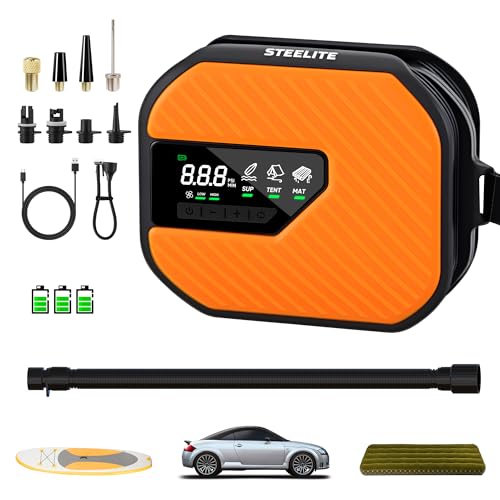
- 50 PSI maximum pressure
- 400 L/min rapid airflow and dual-stage inflation
- Nine adapters plus auto-off and deflation
Best For: Beginners needing one pump for SUPs and varied inflatables
Best Car-Powered Option

- 12V car power with a 10-foot cable
- Inflates a 10.6-foot SUP to 12 PSI in about six minutes
- SUP, tire, and deflation modes with eight adapters
Best For: Beginners who inflate beside a vehicle and want tire capability
Best 12V Electric Pick – Fast Dual-Stage SUP Pump
For beginners comparing paddleboard pumps for beginners, this corded electric model is a practical choice when you plan to inflate near your vehicle. Its dual-stage system reaches up to 20 PSI, while the LCD control and auto-shutoff simplify setup.
Best For: Beginners who want fast inflation from a car and do not need a rechargeable battery.
Pros:
- Dual-stage inflation combines high volume with high pressure.
- LCD pressure control and automatic shutoff help prevent overinflation.
- Inflates and deflates, with six universal nozzles for other inflatables.
- Includes a 12V car connector, flexible hose, and carry handle.
Cons:
- Requires access to a 12V DC outlet or car cigarette lighter.
- At 4.2 pounds, it is heavier than the rechargeable options listed here.
This is a straightforward, feature-rich option for car-based launches. Choose it if fast 20-PSI performance and broad nozzle compatibility matter more than cordless operation.
Best Compact Battery Pick – CYCPLUS Smart SUP Pump
If portability is your priority when shopping for paddleboard pumps for beginners, the CYCPLUS Smart SUP Air Pump offers cordless operation in a compact package. Its 38.48Wh battery, 20-PSI maximum pressure, and automatic shutoff make it convenient for single-board outings.
Best For: Beginners who want a lightweight rechargeable pump for trips away from a car outlet.
Pros:
- Battery-powered design avoids dependence on a 12V car connector.
- Dual-stage inflation reaches up to 20 PSI and includes auto-off.
- Digital display reports pressure with stated accuracy within ±0.2 PSI.
- Can inflate three 10.6-foot boards to 12 PSI or two to 15 PSI per charge.
Cons:
- Full recharging takes about eight hours according to the supplied notes.
- Battery capacity and performance depend on the selected board pressure.
The CYCPLUS is a strong convenience pick for users who value cordless portability. Its included hose, seven nozzles, and deflation function also make packing and multi-inflatable use easier.
Best Rechargeable Value – Hydrohero 20 PSI Pump
The Hydrohero is an approachable option for beginners looking for paddleboard pumps for beginners with rechargeable convenience and clear controls. It uses a dual-stage system, reaches 20 PSI, and is rated to inflate a 10.5-foot SUP to 12 PSI in about five minutes.
Best For: Beginners who want a portable battery pump with fast charging and useful included accessories.
Pros:
- Inflates a 10.5-foot SUP to 12 PSI in about five minutes.
- Rechargeable battery can handle three boards to 12 PSI or two to 15 PSI when fully charged.
- LED screen supports preset pressure monitoring and three operating modes.
- Includes deflation, seven nozzles, a Type-C cable, and a waterproof storage bag.
Cons:
- Charging plug is not included.
- Requires a charger supporting at least 5V/2A for charging.
With its five-minute inflation claim, 2.5-pound weight, and two-year manufacturer guarantee, the Hydrohero balances speed and portability well. It is especially practical for beginners who want a self-contained setup kit.
Best High-Pressure Car Pick – 22 PSI Portable Pump
For beginners choosing paddleboard pumps for beginners who launch beside a vehicle, this 12V model offers a simple, high-pressure setup. It reaches 22 PSI, uses dual-stage inflation, and stops automatically at the selected pressure.
Best For: Beginners who want a budget-conscious car-powered pump with extra pressure headroom and easy deflation.
Pros:
- 22-PSI maximum pressure works with inflatable SUP boards, kayaks, and boats.
- Dual-stage airflow provides rapid filling followed by pressure finishing.
- Clearly labeled inflate and deflate ports simplify setup and pack-down.
- Includes a 105-centimeter hose and six universal valve adapters.
Cons:
- Requires a 12V DC car outlet.
- Its stated standard-SUP inflation time is about 10 minutes, slower than the fastest rechargeable model listed here.
This pump is a sensible choice when you want straightforward controls and strong compatibility without managing a rechargeable battery. The longer hose can also help when inflating at the water’s edge near your car.
Reliable Manual Choice – Lightweight SUP Hand Pump
For beginners comparing paddleboard pumps for beginners, this manual SUP pump offers a straightforward, portable way to inflate an inflatable paddle board or boat. Its 27.5 PSI maximum pressure, built-in gauge, and 4.5-foot hose support practical setup without relying on electricity.
Best For: Beginners who want a lightweight manual pump for paddle boards and inflatable boats.
Pros:
- Reaches up to 27.5 PSI with a 2,200-cubic-centimeter air-flow capacity.
- Built-in pressure gauge helps monitor inflation.
- Includes an HR adapter compatible with Halkey Roberts, Bravo, and similar valves.
- Aluminum shaft and sand-protection filter support a lightweight, reliable design.
Cons:
- Manual operation requires physical effort.
- It does not offer automatic inflation or deflation.
This is a practical entry-level option when portability and independence from a power source matter more than effortless inflation. The pressure gauge and broad valve compatibility make it easier for beginners to use.
Hands-Free Convenience – 20 PSI Car-Powered SUP Pump
For beginners evaluating paddleboard pumps for beginners, this corded electric model is designed to reduce setup effort at the launch point. It connects to a vehicle’s 12V cigarette lighter, inflates to 20 PSI, and includes automatic deflation plus a digital pressure display.
Best For: Drivers who inflate paddle boards near a vehicle and want hands-free operation.
Pros:
- Inflates a regular stand-up paddle board in approximately 10–15 minutes, according to the supplied notes.
- Automatic deflation can complete in about 3 minutes.
- LCD display shows current pressure, while controls adjust pressure in 0.5 PSI increments.
- Six adapters support paddle boards, mats, floating pads, and other inflatables.
Cons:
- Requires access to a 12V vehicle connector.
- At 4 pounds, it is heavier than the supplied cordless pump.
- Its 1-meter hose is shorter than the manual pump’s 4.5-foot hose.
This pump is a convenient beginner-friendly choice for vehicle-based outings. Its display, pressure controls, and deflation function simplify the process, though it is less flexible away from a car.
Most Portable Electric Option – Cordless 20 PSI SUP Pump
For beginners choosing among paddleboard pumps for beginners, this rechargeable electric pump combines cordless operation with automatic inflation and deflation. Its 20 PSI maximum, dual power options, smart LED display, and multiple modes make it suitable for varied outdoor setups.
Best For: Beginners who want a compact electric pump for beach, lake, and other locations without convenient power access.
Pros:
- Three 4,000mAh batteries provide a total 12,000mAh capacity and can inflate and deflate up to three boards from 0–15 PSI on one charge, according to the supplied notes.
- Supports USB-C charging and includes a 12V DC car cable for flexible power.
- Large LED screen shows current and target pressure, with four operating modes.
- Lightweight 2.61-pound design includes a built-in handle and seven interchangeable nozzles.
Cons:
- Maximum pressure is 20 PSI, lower than the supplied manual pump’s 27.5 PSI.
- Battery runtime depends on the selected pressure and inflation workload.
This is the most flexible option of the three for beginners who want to avoid hand pumping and are not always beside a vehicle. The rechargeable design is especially useful for outdoor trips, while the car adapter provides a backup power option.
Best Battery-Friendly Pick – Rechargeable 22 PSI SUP Pump
For beginners comparing paddleboard pumps for beginners, this portable electric model is a practical choice when you want cordless convenience with a backup power option. Its rechargeable battery, 12V car connection, preset pressure control, and auto-shutoff simplify setup at the launch site.
Best For: Beginners who want a compact rechargeable pump with car-power backup for paddle boards and other inflatables.
Pros:
- Dual power supports the built-in battery or a 12V car connection.
- Digital controls, real-time pressure display, and automatic shutoff make inflation straightforward.
- 22 PSI maximum pressure, deflation capability, seven adapters, and a built-in flashlight add versatility.
- Lightweight 2.73-pound design includes a carrying handle and storage bag.
Cons:
- Inflating a 10.5-foot SUP to 12 PSI takes about 8.5 minutes.
- Pressure-sensor calibration may be needed when the pump shows a nonzero reading with no hose attached.
This is a well-rounded beginner option for paddlers who value portability and battery flexibility. Its 22 PSI ceiling is suitable for the stated SUP use, while the included adapters make it useful beyond paddle boards.
Best High-Pressure Versatility – 50 PSI Dual-Stage Pump
Among paddleboard pumps for beginners, this dual-stage electric pump stands out for its high pressure rating and broad accessory support. Preset modes, a digital display, and automatic shutoff help reduce guesswork when inflating a SUP, tent, mattress, or boat.
Best For: Beginners who want one portable pump for SUPs and multiple outdoor inflatables.
Pros:
- 50 PSI maximum pressure provides substantial range for different inflation tasks.
- Dual-stage operation combines 400 L/min rapid airflow with 80 L/min high-pressure inflation.
- Automatic shutoff and real-time digital readings support more controlled inflation.
- Includes inflation and deflation functions, preset modes, and nine valve adapters.
Cons:
- The supplied details list an AC power plug, so buyers should confirm power compatibility for their launch setup.
- The plastic construction may be less rugged than a metal-bodied pump.
This model is a flexible all-purpose inflator for users who expect to handle more than a paddle board. Its dual-stage design prioritizes both fast airflow and pressure control, while the two-year warranty adds extra reassurance.
Best Car-Powered Option – 12V 50 PSI SUP Pump
If you prefer dependable vehicle power, this 12V model is a practical entry among paddleboard pumps for beginners. It combines SUP, car-tire, and deflation modes with a clear LED display, automatic shutoff, and a long power cable for flexible setup.
Best For: Beginners who inflate from a vehicle and want one pump for paddle boards, tires, and other inflatables.
Pros:
- 50 PSI maximum pressure and 12V cigarette-lighter power suit vehicle-based use.
- Inflates a 10.6-foot board to 12 PSI in about six minutes according to the supplied notes.
- Three modes cover SUPs, car tires, and deflation, with selectable PSI or BAR units.
- Includes an 8-adapter set, 10-foot power cable, LED display, and emergency lighting modes.
Cons:
- It requires a 12V car socket rather than operating as a cordless pump.
- The one-year warranty is shorter than the two-year coverage listed for one competing model.
This is a strong fit for beginners who usually launch near their car and want quick board inflation. Its extra tire mode and emergency-lighting functions make it more useful for road trips, though vehicle access is essential.
How We Picked the Best Paddleboard Pumps for Beginners
We focused on the features that matter most when learning to prepare an inflatable SUP: straightforward controls, useful pressure limits, dependable valve compatibility, and a manageable size for transport. The selection includes dual-stage electric pumps for faster inflation, rechargeable options for locations without a car outlet, 12V models for roadside convenience, and a manual pump for users who prefer a simple backup.
We also considered deflation capability, automatic shutoff, digital displays, included adapters, battery capacity, and the practical difference between advertised maximum pressure and the pressure your board actually requires. A pump does not need the highest PSI rating to be a good choice; it needs to reach your board’s recommended pressure consistently.
Quick Comparison
| Pump type | Best for | Main advantage | Potential trade-off |
|---|---|---|---|
| Rechargeable electric | Remote launches and frequent users | No car connection required | Needs charging and battery care |
| 12V electric | Drivers launching near a vehicle | Consistent power for longer inflation | Must remain near the car |
| Dual-stage electric | Faster setup | Combines high airflow with final pressure | Can be louder than a hand pump |
| Hand pump | Backups and occasional use | Lightweight and independent of batteries | More physical effort |
Key Buying Factors for Paddleboard Pumps for Beginners
Pressure Control and Automatic Shutoff
Check your board’s recommended PSI first, then choose a pump with a digital display or clear gauge and an auto-off function. These features reduce guesswork and help prevent overinflation. A 20- or 22-PSI pump is sufficient for many inflatable paddleboards, while higher ratings provide headroom rather than a requirement to inflate that high.
Power Source and Battery Capacity
Rechargeable pumps are convenient for beaches, campsites, and trailheads, but runtime varies with board size, target pressure, temperature, and battery age. A 12V pump is often the safer choice for multiple boards because the vehicle can provide continuous power. If you choose cordless, charge it fully and consider carrying a manual backup.
Inflation Speed, Noise, and Portability
Dual-stage pumps generally move air quickly at low pressure and switch to a higher-pressure stage for the final part of inflation. Look for a compact body, practical cable length, secure hose connections, and storage for adapters. Electric pumps are convenient but noisy, so avoid placing the outlet directly beside other people.
Valve Fit and Deflation
Confirm that the package includes the correct SUP valve adapter, commonly a compatible Halkey-Roberts-style fitting. A deflation mode is useful when packing the board away, especially if you regularly travel with limited storage space.
Who Should Buy Which Paddleboard Pumps for Beginners?
- Choose a rechargeable electric pump if you launch away from a vehicle and want the least physical effort.
- Choose a 12V car pump if you usually inflate beside your car or need dependable power for several boards.
- Choose a dual-stage model if reducing setup time is your main priority.
- Choose a hand pump if you value low weight, quiet operation, or an emergency backup.
- Choose a higher-PSI model only when you want extra capacity or use other inflatable equipment; always follow the board manufacturer’s pressure limit.
For most first-time owners, the best overall balance is an electric pump with automatic shutoff, a readable display, the correct valve adapter, and either a charged battery or reliable 12V power. Those essentials matter more than an impressive maximum PSI number.